
QUICK DETAILS:
Route: Hoi An → Son Tay → Hoi An
Distance: 391 km
Duration: 2 days 1 nights
Required: Experienced rider
Scenery: mountains, jungle, rivers, valleys, waterfalls, highland
Attractions: spectacular views, great riding, stream, waterfall, trocial forest,..
Road Conditions: mostly good, smooth, paved roads, generally light traffic
Best Time: March → September (dry season)
Cost: 50$ USD
SECTIONS:
Section 1: Hoi An → Hiep Duc → Son Tay | 200 km
Section 2: Son Tay → Di Lăng → Tra Bong → Quang Ngai → Hoi An | 190 km
HIGHTLIGHTS OF THE TRIP
Winding, scenic mountain roads
Lush primary forests
Endless mountain ranges
Ethnic minority villages with stilt houses
Towering areca palms in the middle of the forest
Streams that merge into small rivers
Eagles soaring over cliffs
Golden rice fields glowing in the sun
The warmth and friendliness of local people
TIPS FOR RIDING A MOTORBIKE
Make sure you’re experienced: Some sections have slopes up to 10%, so solid motorbike riding skills are required.
Check your bike before leaving: Brakes, tires, lights, and horn should all work properly. Breakdowns in remote mountain areas can be very inconvenient.
Slow down on sharp curves: Mountain roads are winding and there may be vehicles coming from the opposite direction. Keep to the right and maintain a safe speed.
Use gears wisely: On semi-automatic or manual bikes, use lower gears when going downhill to control speed and avoid overusing the brakes.
Be extra careful in the rain: The road can become slippery with moss or mud. Reduce speed and keep a safe distance.
Fill up your tank before entering the mountains: Gas stations are sparse. Always top up in major towns before continuing.
Bring water and snacks: It’s a long ride with few shops along the way, so you may need to stop and refresh.
Keep your phone charged with backup power: Signal may be weak in some mountain areas, but you still need your phone for navigation or emergencies.
Always wear a good-quality helmet: It’s not just the law, it’s essential for safety on steep mountain roads.
Respect local communities: Slow down when passing through villages, and watch out for pedestrians, children, or livestock on the road.
Dak Drinh Lodge – An Untouched Gem in Vietnam’s Central Highlands
Hello everyone! I’m excited to continue sharing my journeys across Vietnam with friends from all over the world.
From my own travel experiences, Hoi An is the perfect base for long-term exploration of Central Vietnam. To the north, you have Da Nang, Hai Van Pass, Hue, the DMZ zone, and Phong Nha. To the west, you’ll find remote mountain ranges along the Lao border. To the east lies the endless ocean and pristine islands. To the south are even more beautiful beaches. And to the southwest stretches the Central Highlands — mountains, thick forests, diverse cultures, and the timeless traditions of the ethnic minorities of Tay Nguyen.
I’ve explored these southwest routes many times, and yet they never feel repetitive. Each trip brings a fresh perspective, a new sense of wonder, and the same deep peace in my heart.
This time, my destination is Dak Drinh Lodge — a hidden gem by a jade-green lake, surrounded by mountains and forests.

Section 1: Day 1 - The journey from Hoi An to Dak Drinh lodge
At 6 am, our group of 11 adults and 5 children set off from Trace Travel Hoi An with 5 motorbikes and one car. The weather forecast predicted rain by evening, so we left early to arrive before it started. Luckily, the morning was perfect — clear skies, a light breeze, and a pleasant 30°C.

Dak Drinh lies about 180 km southwest of Hoi An, along the Truong Son Dong Road. This scenic route runs parallel to the eastern edge of the Truong Son mountain range, passing through highlands and remote mountain villages.
Leaving Hoi An, we crossed Cua Dai Bridge, headed south for a few kilometers, then turned west. After cutting across Highway 1A and passing small villages, we merged onto Highway 14E toward Hiep Duc. Beyond Hiep Duc, we turned onto the Truong Son Dong Road.

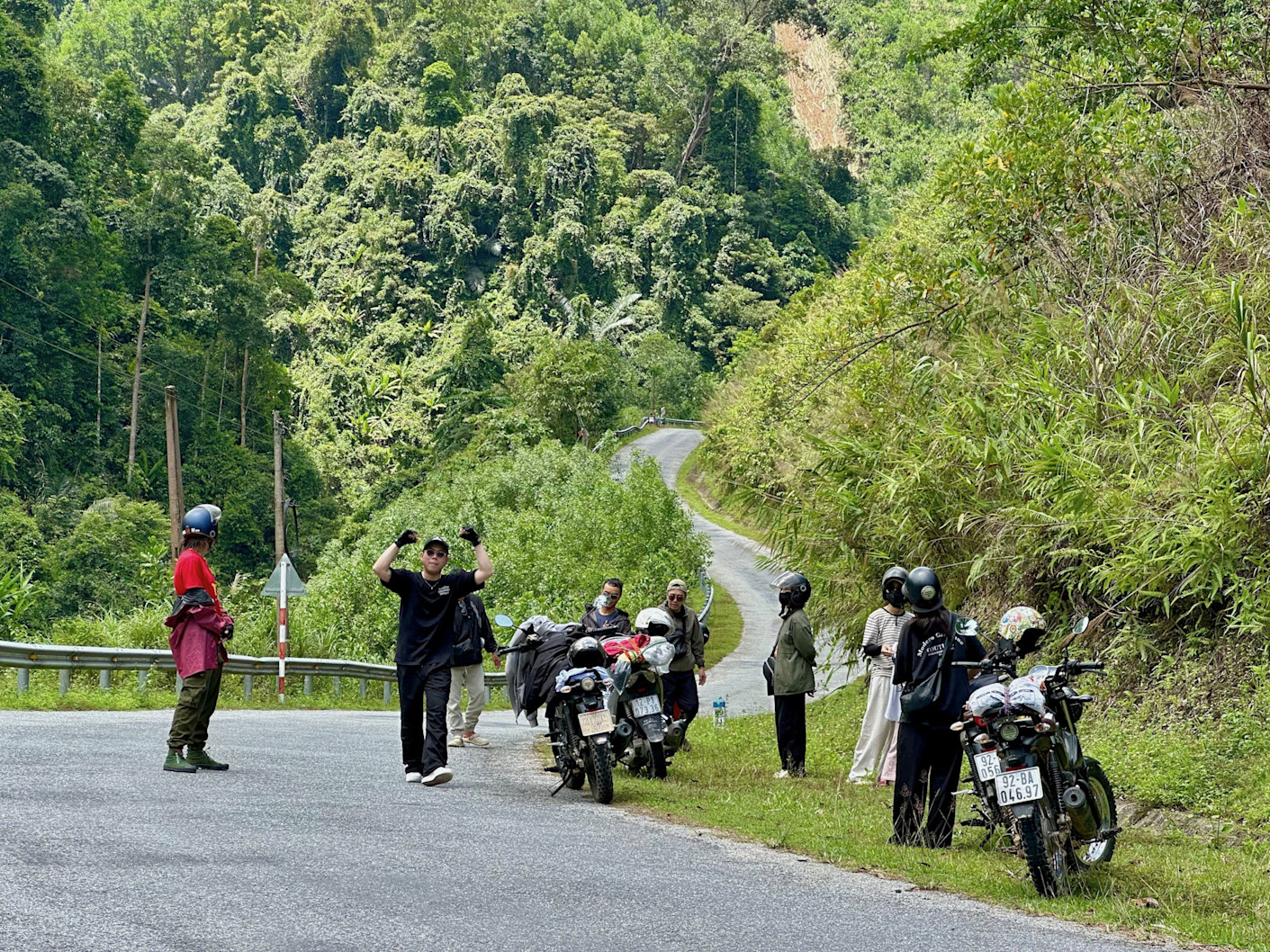
And the landscape began to change. The houses thinned out, replaced by rolling forests and towering peaks. The road curved around mountains, opening into breathtaking vistas. Occasionally, we glimpsed ethnic minority villages hidden in the valleys — wooden stilt houses, smoke from kitchen fires, areca palm groves, and terraced fields carved into the hillsides.


Tranh River Dam

Some sections of the road have slopes as steep as 10%
By 1 pm, after a long but beautiful ride, we reached Son Tay, a small town in Quang Ngai Province, set high on the plateau. From here, we made our way to Dak Drinh Lodge, perched by the reservoir of the Dak Drinh hydropower dam.
This eco-lodge is remote, surrounded by Ca Dong ethnic villages, with stilt houses scattered along the lakeshore. The final road into the lodge is narrow and steep, so Google Maps can be tricky here — it’s better to follow the official directions provided by the lodge.


There are two ways to reach Dak Drinh Lodge:
By boat: From Son Tay, continue south on the Truong Son Dong Road until km 168, then turn right and drive 3–4 km to Mr. Nghia’s house (the boatman). Park your vehicle there, walk down to the pier, and take a boat ride across the emerald lake. The moment you step on the boat, the cool breeze and magical scenery make you feel like you’re entering a fairytale.

By road: If you’re on a motorbike and want a bit of off-road adventure, follow the signs for Dak Drinh Lodge. The last 250 meters before the stilt house feels like crossing a symbolic barrier into a hidden world. Once inside, you’ll find yourself in a quiet, secluded valley by the lake.
Please be careful of this part, follow our direction so you do not get lost here:


At the entrance, we were greeted by Mr. Dung, the lodge’s owner, and his three friendly dogs. After resting a bit, he showed us to our rooms. The lodge has about six wooden houses, each fitting 3–5 mattresses depending on size. There are two shared bathrooms (with hot showers). Facilities are simple but comfortable, covering all the basics you need.


Once settled, we gathered in the communal area, chatting about the trip while the kids played. The tiredness quickly faded, replaced by laughter and the serene backdrop of green hills.


By 6 pm, it was time for dinner — a cozy BBQ prepared by Mr. Dung, complete with charcoal grill, fresh meat, and vegetables. As heavy rain poured outside, we sat together grilling food inside the wooden house. The atmosphere was warm, rustic, and unforgettable. That night, besides our group, there was also a Vietnamese family and two foreign female travelers staying there. For those who don’t fancy BBQ, the lodge also serves family-style meals and vegetarian options.


Section 2: Day 2 – Morning by the Lake and the Road Back
At 6 am, we slowly woke up after a restful night. Breakfast, included in the stay, was simple: instant noodles with egg and hot coffee. The crisp, cool morning air and sunshine made everything taste better.


After breakfast, we strolled around the lodge, enjoying the fresh air and taking photos of the lake and mountains.


Dak Drinh Lodge is not just a place to stay, but an unforgettable journey into Vietnam’s highlands. The lodge’s simplicity, its stunning location by the emerald lake, and the warm hospitality make it truly special.
For more information or booking, you can check their official website: dakdrinhlodge.com
By 9 am, we packed up and began the journey back to Hoi An. From Dak Drinh Lodge, we returned to Son Tay town, then continued eastward. Leaving the Truong Son Dong Road, we followed Provincial Road DT623 to Di Lang, another small town.


The mountain roads were as stunning as ever — winding passes, dense forests, and endless peaks. In Di Lang, we found essential services like fuel, food, and repair shops. From there, we continued along DT626 to Tra Bong town, a perfect spot for a lunch break. We were already quite tired, so we decided to stop for lunch here. Since it was Vietnam’s National Day (September 2nd), many restaurants were closed. Luckily, while stopping to refuel, a local kindly pointed us to one place that was still open.

Address: 734 Tra Bong Khoi Nghia, Quang Ngai
After a hearty meal, it was time to make a decision: should we continue along the winding mountain roads back to Hoi An, or choose the flatter, smoother route that leads us back to the coastal highway?
Option 1: The coastal route (faster, easier): If you need to return quickly or if the weather turns bad, head east on Highway 24C back to Highway 1A, then north along the coast on Vo Chi Cong Road toward Hoi An. This route avoids mountain passes and is smoother, though less adventurous. Still, the countryside scenery — especially during rice season — is peaceful and cinematic, like a Studio Ghibli film. Once you hit Highway 1A, the traffic with large trucks and buses can feel overwhelming, but it’s only a short stretch before you rejoin the coastal road. On the way back, you can visit sites like the Vietnamese Heroic Mother Monument or Tam Thanh Mural Village.

Option 2: The mountain route (scenic, adventurous): If you’re not in a rush and want to stay in the cooler highlands, cross the red bridge at Tra Bong and follow Highway 24C west toward Bac Tra My town. This road is slower and longer but offers cooler weather and forested landscapes. Bac Tra My is also a good spot to refuel. From there, continue along Highway 40B through Tien Phuoc District, known for the centuries-old Loc Yen Ancient Village, before reaching Tam Ky city. Finally, take Vo Chi Cong coastal road north back to Hoi An

We had a good trip and unforgetable memories. Thank you for following the blog. See you in the next adventure!
Trace Travel Team

